Puglian Caciocavallo: how to recognize the artisanal version
Condividi
Caciocavallo is one of the most recognizable cheeses from the South: that flask-like shape, with the "little head" on top and the rope tied tight around its neck, can be recognized from afar. Precisely for this reason, it is also one of the most imitated. On the shelves, you will find caciocavalli made by hand by small cheesemakers as well as industrial products that merely copy its shape.
In this guide, we explain what a Puglian caciocavallo really is, how to read the label, and what signs tell you that you are holding an artisanal cheese.
What is caciocavallo
Caciocavallo is a pasta filata (stretched-curd) cheese. After a short maturation period, the curd is immersed in hot water and worked by hand until it becomes elastic and can be "spun." The cheesemaker shapes it like a pear, closes the little head, and ties the wheels in pairs with a rope.
From here, according to the most common explanation, comes the name: the tied wheels were hung a cavallo (astride) of a beam to age. An ancient gesture that gave the cheese its shape, which has remained the same to this day.
Caciocavallo, Podolico caciocavallo, DOP caciocavallo: what is the difference?
"Caciocavallo" indicates the type of cheese, not a precise origin or quality. To find your way around, it is useful to know three things:
- Caciocavallo Silano DOP: this is the protected designation of origin for caciocavallo, with precise regulations regarding production area and processing. The area includes several regions in the South, including Puglia. If a cheese is DOP, the mark is shown on the label.
- Podolico caciocavallo: it is made with the milk of the Podolica cow, an ancient breed raised on free-range or semi-free-range pasture. It produces little milk, which is very aromatic, and for this reason, it is a rare and expensive cheese. The Podolico caciocavallo from the Gargano is also a Slow Food Presidium.
- Just "caciocavallo": it can be an excellent artisanal cheese or an industrial product. To understand which, you need to look at the label, the shape, and who produces it.
How to recognize an artisanal caciocavallo: 6 signs
1. There are few ingredients
An artisanal caciocavallo is born from milk, salt, and rennet. Sometimes there are also lactic ferments. That's it. If you find preservatives or colorings on the label, you are dealing with a product designed to last on the shelf, not to be good. Lysozyme, for example, is a preservative derived from egg that must be declared on the label because it is an allergen.
2. The rind is thin and natural
The rind of an artisanal caciocavallo forms on its own during aging: it is smooth, thin, and straw-colored, darkening over time. Be wary of rinds that look shiny like plastic, colored waxes, and labels stating "inedible rind": these often indicate surface treatments, for example against mold.
3. The shape is not perfect
A hand-molded shape is never identical to another. A slightly crooked head, rope marks on the neck, small irregularities on the surface: these are the cheesemaker's signature. Wheels that are all identical, smooth, and symmetrical often come from molds.
4. The weight is "approximate"
During aging, the cheese loses water and loses weight, and each wheel loses weight differently. For this reason, an artisanal caciocavallo is almost always sold by an approximate weight: "about 500g," "about 1kg." A weight that is identical down to the gram is a clue to industrial production.
5. Paste, color, and aroma
When cut, the paste is compact, ranging from white to straw yellow, becoming more intense with aging. The aroma should be reminiscent of milk and butter, with stronger notes in aged wheels. A flat or plastic-like smell does not promise anything good.
6. You know who made it
This is the most important sign. An artisanal caciocavallo has a name behind it: a dairy, a farm, a specific area. If the person selling it to you cannot tell you where the milk comes from and who spun the curd, ask yourself a few questions. We discuss this more generally in our guide on how to recognize authentic Puglian typical products.
Fresh, semi-aged, or aged?
Aging completely changes the character of the caciocavallo:
- Fresh (a few weeks): sweet, soft, delicate. Excellent for cooking, because it melts well.
- Semi-aged (roughly two to four months): more compact and flavorful, but still sweet. It is the most versatile: it is great on a cheese board and in the kitchen.
- Aged (beyond): hard paste, intense flavor that can become spicy. To be enjoyed in flakes, at a leisurely pace.
Small wheels age faster than large ones: this is why a mini caciocavallo reaches its balance more quickly.
Our mini caciocavallo
The artisanal Puglian caciocavallo that you find in the Bottega comes from the Gargano. It is a small wheel, weighing about 500 grams, semi-aged for about 100 days. The ingredients are what they should be: milk, salt, and rennet, with no preservatives or colorings. The rind is thin and can be eaten.
On the palate, it is bold but sweet; it does not bite. It arrives vacuum-packed and labeled, and the weight may vary slightly from one wheel to another: this is the sign of a handmade cheese.
How to eat it
- On a cheese board, in thin slices, with artisanal soppressata and a drizzle of raw wildflower honey from Salento: the contrast between cheese and honey is a classic.
- Grilled or on the embers, in thick slices, until the surface forms a crust and the heart becomes stretchy.
- On a slice of homemade bread toasted in the oven.
- With a Puglian red with character, such as the Guarano Negroamaro Appassimento.
How to store it
In the refrigerator, between 4 and 8 °C. Once you have opened the vacuum seal, wrap it in food paper or a clean cotton cloth, not in plastic wrap: the cheese needs to breathe. Take it out of the fridge half an hour before serving, so that the aromas and flavors open up.
Frequently asked questions
Is the caciocavallo rind edible?
It depends. If the rind is natural, like ours, yes. If you find "inedible rind" on the label, it should be removed.
Is the caciocavallo spicy?
Only when it is very aged. Fresh and semi-aged are sweet.
Is your caciocavallo DOP?
No. It is an artisanal caciocavallo from the Gargano that is not part of a protected designation. Its value lies in the milk, the handmade processing, and the aging.
Can it be given as a gift?
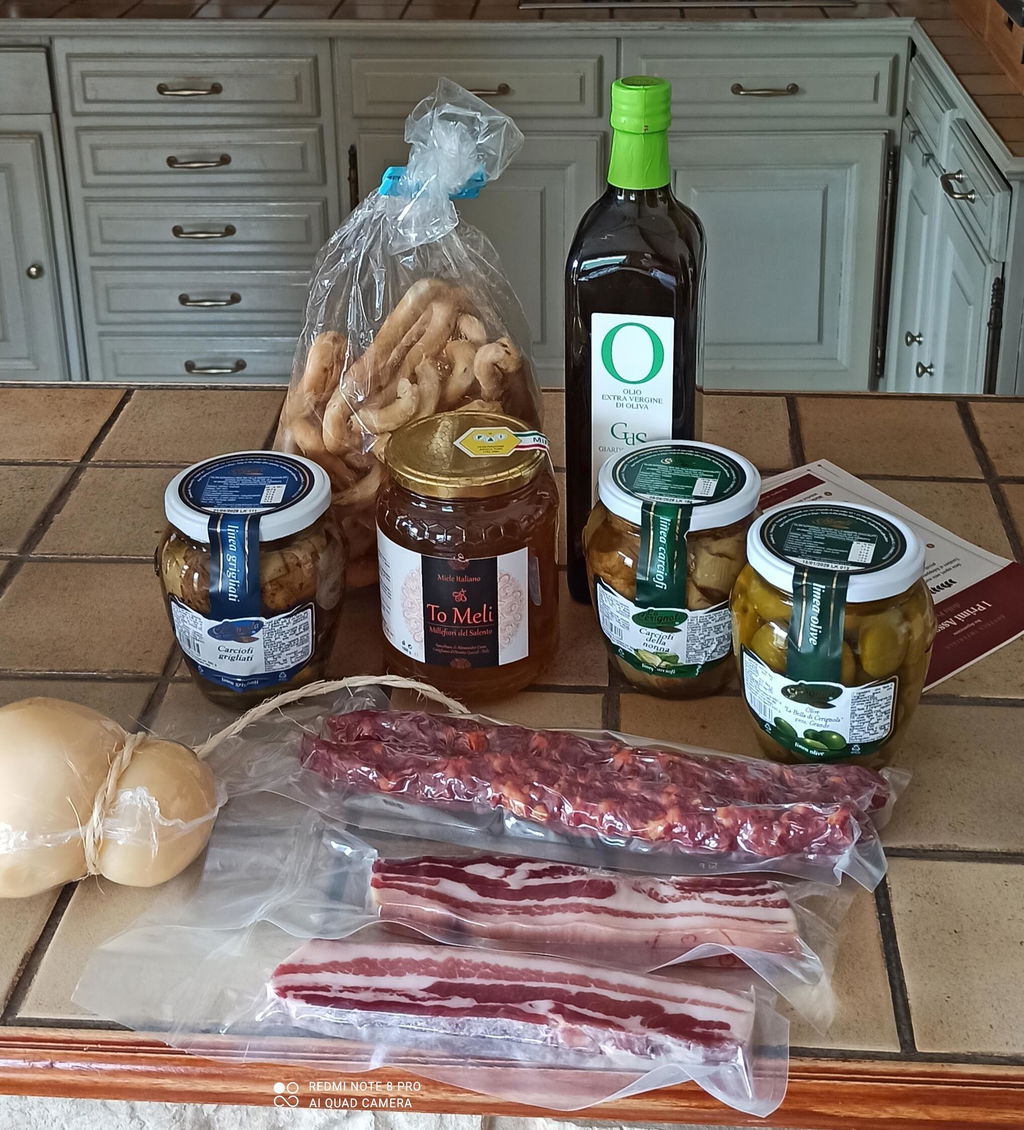
Yes, it is one of the stars of the "A First Taste of Puglia" box and the "Great Puglian Gift Basket".
Caciocavallo is a simple cheese, but not a trivial one. When you know what to look for, the difference between the handmade one and the mass-produced one is immediately visible. And you can taste it at the first bite.