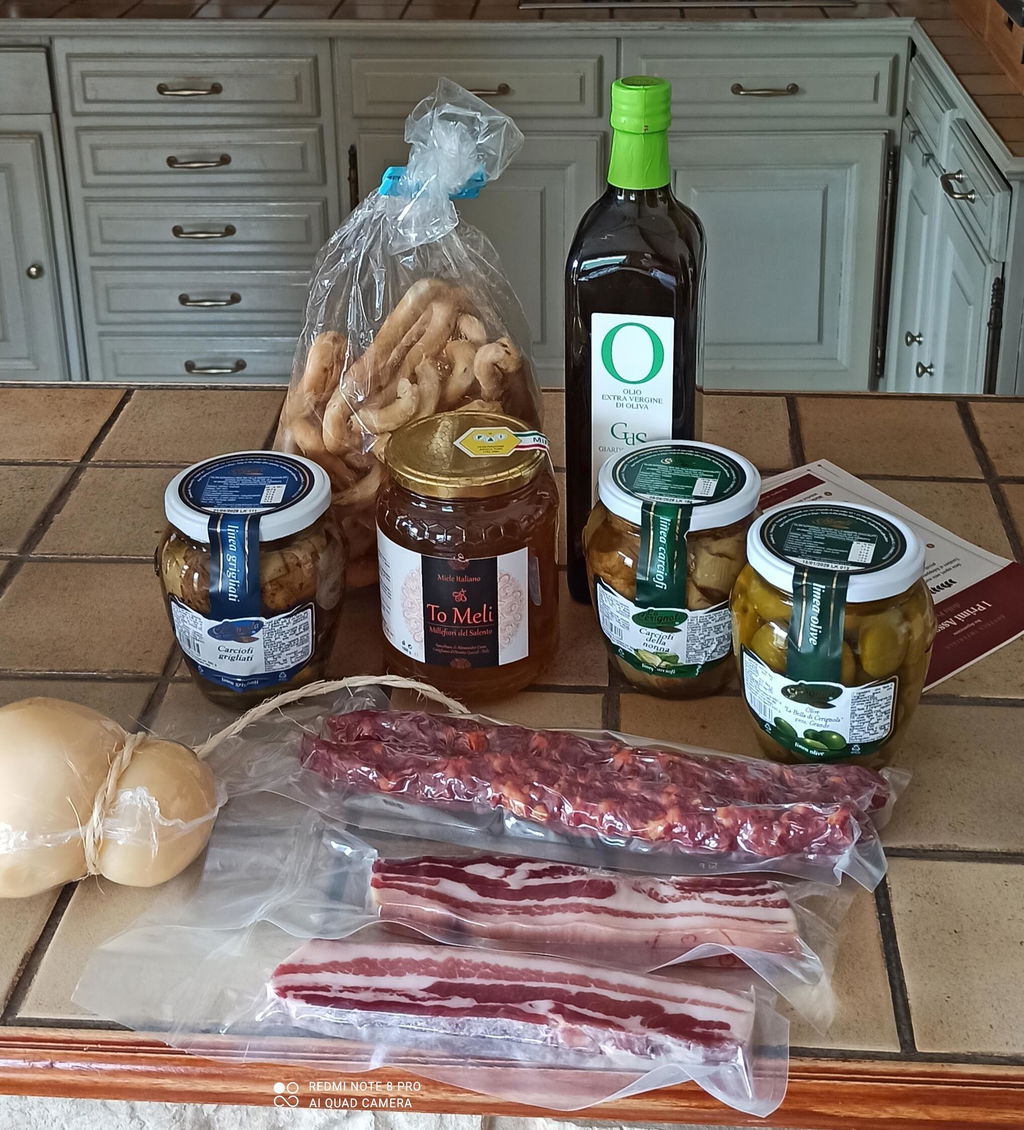
Typical Apulian products: the complete guide, province by province
Condividi
Typical Apulian products are the foods born from the land and history of Puglia: extra virgin olive oil, durum wheat bread, taralli and friselle, cheeses like canestrato and burrata, cured meats like capocollo, preserved vegetables in oil, legumes from the Murgia, honey, and almond sweets. Many are protected by a DOP or IGP label. Many others have no labels, but have existed for centuries in homes and village bakeries.
This guide lists them, province by province. And alongside the products, it lists the names of those who make them. Because a typical product, without the one who produces it, is just a label.
In brief: the most important typical Apulian products
• Extra virgin olive oil: five DOP and one regional IGP.
• Pane di Altamura DOP, taralli, friselle, and scaldatelli.
• Cheeses: Canestrato Pugliese DOP, Burrata di Andria IGP, Mozzarella di Gioia del Colle DOP, caciocavallo.
• Cured meats: capocollo from Martina Franca, soppressata, sausage with fennel seeds.
• Vegetables in oil and preserves: lampascioni, artichokes, sun-dried tomatoes, olives.
• Legumes: Lenticchia di Altamura IGP, black chickpeas from the Murgia, fava beans, grass peas (cicerchia).
• Sweets and honey: almonds, dried figs, cartellate, pasticciotto, wildflower honey.
Watch the video: typical Apulian products explained for the moments when they save your day.
What makes an Apulian product "typical"
"Typical" is not a trademark. Anyone can write it on packaging. To help you navigate, there are four certifications that do have a precise meaning:
• DOP (Protected Designation of Origin): the entire product is created and processed in a defined area, according to a set of regulations.
• IGP (Protected Geographical Indication): at least one stage of production takes place in the indicated area.
• PAT (Traditional Agri-food Products): products processed using methods unchanged for at least 25 years, recognized by the Region. Puglia has hundreds of them.
• Slow Food Presidia: small-scale production at risk of disappearing, which Slow Food helps protect.
Then there is everything else: products that don't have any labels, because the producers are too small to afford an expensive certification. Often, these are the most authentic. That is exactly where we operate.
Apulian extra virgin olive oil
Puglia is Italy's leading region for olive oil production. It has five DOP oils: Dauno, Terra di Bari, Collina di Brindisi, Terre Tarentine, and Terra d'Otranto. Since 2019, there has also been the Olio di Puglia IGP.
Varieties change from north to south. The Coratina yields intense, bitter, and spicy oils. The Peranzana is typical of the Foggia area. The Ogliarola and the Cellina di Nardò are staples in Salento.
Who produces it for us. Mario Iaculli runs the family-owned oil mill in Cerignola, in the Tavoliere, with his brother and wife. The mill has been in the family for over fifty years. The oil we bring to our shop is his: 100% Apulian, monovarietal Coratina, cold-pressed. 👉 Coratina Extra Virgin Olive Oil
Bread and bakery products
Durum wheat is the base of everything. Pane di Altamura DOP was the first bread in Europe to receive a DOP. Then there are the dry products, born to last: taralli, friselle, and scaldatelli.
The scaldatelli are the great specialty of Ascoli Satriano, in the Dauni Mountains. They are made with flour, fennel seeds, and a few other ingredients. They are cooked twice: first scalded in boiling water, then baked in the oven. Hence the name.
Who produces them for us. Mario Roca's family bakery, now in its second generation. And Francesco Di Biase, a baker for three generations in the Subappennino Dauno, who uses only Italian wheat and remilled semolina. ➡️ 500g Apulian Scaldatelli with fennel seeds
Typical Apulian cheeses
• Canestrato Pugliese DOP: pecorino aged in reed baskets, between Foggia and Bari.
• Burrata di Andria IGP: a shell of stretched-curd cheese filled with stracciatella.
• Mozzarella di Gioia del Colle DOP: cow's milk mozzarella from the Murgia.
• Caciocavallo: stretched-curd cheese aged hanging in pairs. In the Gargano, it is also made with Podolica cow's milk.
• Ricotta forte (scanta): fermented ricotta with a pungent flavor, typical of Salento.
A practical note: burrata, mozzarella, and stracciatella must be eaten within a few days. They don't travel well in a parcel. That's why we only ship aged cheeses, such as caciocavallo aged for at least 4 months. 👉 Artisanal Apulian Podolico Caciocavallo🧀
Apulian cured meats
The most famous is the capocollo di Martina Franca, a Slow Food Presidium, smoked with woods from the scrubland. But every area has its own: soppressata, sausage with fennel seeds, and zampina from Sammichele di Bari, recently recognized as IGP.
Who produces them for us. Mimmo Cordisco is an artisanal butcher from the Subappennino Dauno. He processes pork, lamb, beef, and horse meat. The sweet fennel sausage, soppressata, and capocollo arrive in our shop from him, vacuum-sealed. ➡️ Typical cured meats
Vegetables in oil and preserves: the pantry of yesteryear
Before the refrigerator, summer produce was put into jars. This is how Apulian vegetables in oil were born: artichokes, eggplant, sun-dried tomatoes, peppers. And lampascioni: bitter bulbs of a wild hyacinth, which have always been gathered in the fields and cooked in Puglia.
Olives have a DOP of their own: La Bella della Daunia, the large green olive of Cerignola.
Who produces them for us. Again, Mario from the Tavoliere delle Puglie. His grandmother's artichokes grow on his land and are preserved in sunflower oil. The rustic-style lampascioni are the most sought-after products 👉 Typical Apulian preserves
Legumes, vegetables, and fruit of Puglia
• Lenticchia di Altamura IGP, grown on the Murgia plateau.
• Black chickpea of the Karst Murgia and grass pea (cicerchia): ancient legumes, almost extinct and now defended by Slow Food and small growers.
• Dried fava beans: the base of the purée with chicory, a symbolic dish of peasant cuisine.
• Carciofo Brindisino IGP and Cipolla bianca di Margherita IGP.
• Regina tomato of Torre Canne: cherry tomatoes hung in bunches that last all winter.
• Citrus fruits: Arancia del Gargano IGP, Limone Femminello del Gargano IGP, Clementine del Golfo di Taranto IGP. And the Uva di Puglia IGP table grapes.
Honey, almonds, and sweets
In Puglia, the sweets of the past were made with whatever was available: almonds, figs, honey, vin cotto. This is how almond-stuffed dried figs, Christmas cartellate, mostaccioli, and Salento marzapani (almond paste) were born. More recent, but now a symbol of Lecce, is the pasticciotto.
Who produces it for us. Alessandro Cuna is a beekeeper in Corigliano d'Otranto, in the heart of Salento, a member of the Italian Beekeepers Federation. His honey is a raw wildflower honey that undergoes no heat treatment. ➡️ Wildflower honey
The wines of Puglia
Three names to know: Primitivo (with the Primitivo di Manduria), Negroamaro in Salento, Nero di Troia in the north of the region. 🍷
Typical Apulian products province by province
|
Province |
Typical products |
|
Foggia (Daunia, Gargano, Monti Dauni) |
Olio Dauno DOP, La Bella della Daunia DOP, Canestrato Pugliese DOP, Podolica caciocavallo, Arancia and Limone Femminello del Gargano IGP, scaldatelli from Ascoli Satriano, cured meats from the Subappennino |
|
Barletta-Andria-Trani |
Burrata di Andria IGP, Cipolla bianca di Margherita IGP, Terra di Bari DOP oil, Nero di Troia |
|
Bari |
Pane di Altamura DOP, Lenticchia di Altamura IGP, Mozzarella di Gioia del Colle DOP, zampina di Sammichele IGP, focaccia barese, almonds, Coratina oil |
|
Taranto |
Capocollo di Martina Franca, Clementine del Golfo di Taranto IGP, Terre Tarentine DOP oil, Primitivo di Manduria |
|
Brindisi |
Carciofo Brindisino IGP, Regina tomato of Torre Canne, Collina di Brindisi DOP oil |
|
Lecce (Salento) |
Friselle, Terra d'Otranto DOP oil, ricotta forte, pasticciotto, marzapani, wildflower honey, Negroamaro |
How to recognize a true Apulian product
1. Read who produces it and where. The facility address and company name must be on the label.
2. Read the origin of the raw material, not just where it was packaged.
3. Look for the official DOP and IGP stamps, featuring the European logo.
4. Check the ingredients. A real preserve has a short list.
5. Be wary of generic "typical" labels without a country, a name, or a person behind them.
Where to buy typical Apulian products online
My name is Giuseppe Imperiale. For years, I worked as a courier here in Salento: I delivered packages. Today, I deliver flavors. Bottega Imperiale was born in Castrignano de' Greci, in the province of Lecce, with a simple idea: we don't buy from wholesaler catalogs. We go to the producers, one by one. We choose the small ones because they have less of a voice but a story to tell. Those who buy from us support their work.
If you want all of Puglia in a box, to keep or to give as a gift, choose The Great Apulian Gift Box (€149, free shipping). Inside, you will find products from our producers, chosen to tell the story of the region from north to south. 📦 The Great Apulian Gift Box
A more affordable alternative is the tasting box The First Taste of Puglia (€89.50 shipping included): seven products, from the most delicate to the most robust, with shipping included. 📦 The First Taste of Puglia We ship throughout Italy (free from €89) and to France, Germany, Austria, Belgium, the Netherlands, Luxembourg, Spain, and Denmark.
Frequently asked questions about typical Apulian products
What is the most typical product of Puglia?
Extra virgin olive oil. Puglia has five PDO oils and one regional PGI, and olive trees define the landscape of the entire region. Immediately after come durum wheat products: bread, taralli, and friselle.
Which Apulian products have PDO and PGI status?
Among the best known: the five PDO oils (Dauno, Terra di Bari, Collina di Brindisi, Terre Tarentine, Terra d'Otranto), Olio di Puglia PGI, Altamura Bread PDO, Canestrato Pugliese PDO, Mozzarella di Gioia del Colle PDO, Burrata di Andria PGI, La Bella della Daunia PDO, Lenticchia di Altamura PGI, and Carciofo Brindisino PGI.
What should you bring home from Puglia?
Products that travel well: oil, taralli, friselle, scaldatelli, preserved vegetables in oil, vacuum-packed cured meats, aged cheeses, almonds, and honey. Burrata and mozzarella should be eaten on the spot.
If you returned home empty-handed, also read: The souvenir you didn't manage to bring back from Puglia
Can you ship Apulian products abroad?
Yes, shelf-stable products can be shipped. Bottega Imperiale ships to various European Union countries. Fresh cheeses cannot, because they do not withstand the journey. The rest is well-protected in the packaging.
What are the typical products of Salento?
Friselle, Terra d'Otranto PDO oil, ricotta forte, pasticciotto leccese, marzipan, wildflower honey, ancient legumes like chickling vetch, and Negroamaro wine.