The souvenir you couldn't take home from Puglia...
Bottega Imperiale · What won’t fit in your suitcase — and how to remedy this inconvenience now.
It happens to everyone the same way. On your last day of vacation, you walk into a shop with the idea of taking home half of Puglia. Then you look at your suitcase, look at the check-in scale, remember your low-cost flight, and end up buying a bag of taralli and one small jar. Everything else stays there.
Then you go home, open that jar on an ordinary October evening, and realize you brought back the wrong thing. What you really wanted was the oil from the mill where they let you taste bread, that strange jar the restaurateur put on your plate without explaining what it was, the cheese you ate at the masseria.
This guide serves two purposes: understanding why certain products don’t fit in a suitcase (it’s not your fault, it’s physics and airline regulations) and how to recover them now, without waiting for next summer.
Why the suitcase is the real limit:
The problem isn’t the choice, it’s the medium. Those returning from Puglia by plane face four constraints that no shop can bypass:
– Weight. Twenty kilos of allowance seems like a lot until you pack three half-liter bottles of oil and two glass jars. The cost of extra luggage often exceeds the value of the products.
– Liquids in the cabin. In most Italian airports, the 100 ml per container rule still applies. The exception for up to 2 liters only applies to certain airports equipped with new, latest-generation scanners — Fiumicino, Linate, Malpensa T1, Bologna, Turin — and in some cases only at specific checkpoints or with exceptions for certain routes. Puglia’s airports, at the time of writing, are not covered by the waiver: oil in carry-on luggage from Bari or Brindisi will not pass. I strongly recommend always checking your airport's website before departing.
– Glass. In the hold, a bottle can break, and when that happens, you don't just lose the bottle: you lose your clothes, your book, and your dignity.
– Time. A suitcase locked in a car parked in the sun in August is an oven. Fresh cheeses and cured meats won't arrive home in the condition in which you bought them.
Hence a simple rule that you’d do well to keep in mind for next time: lightweight, dry, and unbreakable things go in the suitcase. Everything else should be shipped.
The five things almost no one manages to bring home:
1. Extra virgin olive oil
It is the number one product visitors regret not bringing, and it is also the most penalized: liquid, heavy, in glass. If you buy it, buy it on the first day and have it shipped, or get it in a tin — it holds up better than glass in the hold. Or, much more simply, order it once you’re back: it’s the only product from your vacation you’ll use every day for the next few months, so it’s truly worth having.
A warning: not everything sold in Puglian tourist shops is Puglian. Check the label for the origin of the olives, the name of the mill, and the harvest season.
2. Glass jars — and the product no one can name
Artichokes, eggplants, mushrooms, lampascioni. They are heavy, fragile, and above all, they are the ones that become a specific regret upon returning, because you can't find them outside of Puglia.
The most common case is the lampascione: that bitter bulb served as an appetizer that almost no tourist can name and that almost everyone searches for on Google months later, describing it as "that kind of bitter little onion." If this happened to you, now you know its name.
3. Bread and baked goods
Friselle, taralli, scaldatelli. Technically they travel well — they are dry and light — but they take up an enormous amount of space and crumble under everything else. Almost everyone buys a symbolic bag and forgets the rest. It’s a pity, because these are the products with the sharpest quality gap compared to the supermarket: a scaldatelli made with re-milled semolina and slow-leavened dough is nothing like what you find at your local store.
4. Aged cheeses and cured meats
A caciocavallo or an aged sausage will survive the trip if vacuum-sealed and if they don't spend hours in the heat. The problem is that almost no one buys them vacuum-sealed on vacation: they buy them at the counter to eat them right there. And they’re right to do so. But then they don't last at home.
5. Burrata — and here we must be very honest
Burrata eaten a few hours after production is an experience that cannot be replicated. Forty-eight hours later, it is a different product. There is no suitcase, cooler bag, or courier that can return that sensation to you, and anyone who tells you otherwise is trying to sell you something.
This is the only Puglian souvenir that cannot be recovered. You must accept it: it stays in Puglia, and it gives you a reason to come back.
What was that thing called?
A small survival dictionary for those who tasted something on vacation and don't know how to look for it:
– Lampascioni — wild bulbs with a bitter taste, preserved in oil. A classic appetizer of the peasant tradition.
– Cacioricotta — a cheese halfway between caciotta and ricotta, grated over tomato pasta. It is not pecorino and it is not ricotta salata.
– Vincotto — grape must cooked for a long time, thick and dark. It is not balsamic vinegar, even if it looks like it in color.
– Grano arso — "burnt" wheat semolina, born from gathering the wheat stalks left in the fields after the harvest. It has a toasted aroma and a dark color.
– Frisella (or frisa) — twice-baked durum wheat bread, to be soaked in water before seasoning.
– Scaldatelli — taralli boiled before being baked, hence the shiny crust and crunchiness.
How to remedy this now?
The good news is that everything that doesn't fit in a suitcase fits easily in a box. Sealed dry products, jarred preserves, oil, honey, and aged items travel well if packed by professionals.
Three things to check before ordering from any site selling typical products:
– Are there producer names? If the site only talks about "selected typical Puglian products" without ever saying who makes them or where, they are likely reselling industrial batches packaged for tourism.
– Are the formats real? Be wary of baskets with fifteen tiny samples: they look nice when opened but just sit in the pantry. Six real products are better.
– What do they say about fresh items? A serious seller clearly tells you what they do not ship. If they promise you burrata like at the masseria, find another site.
Bring back what you left behind
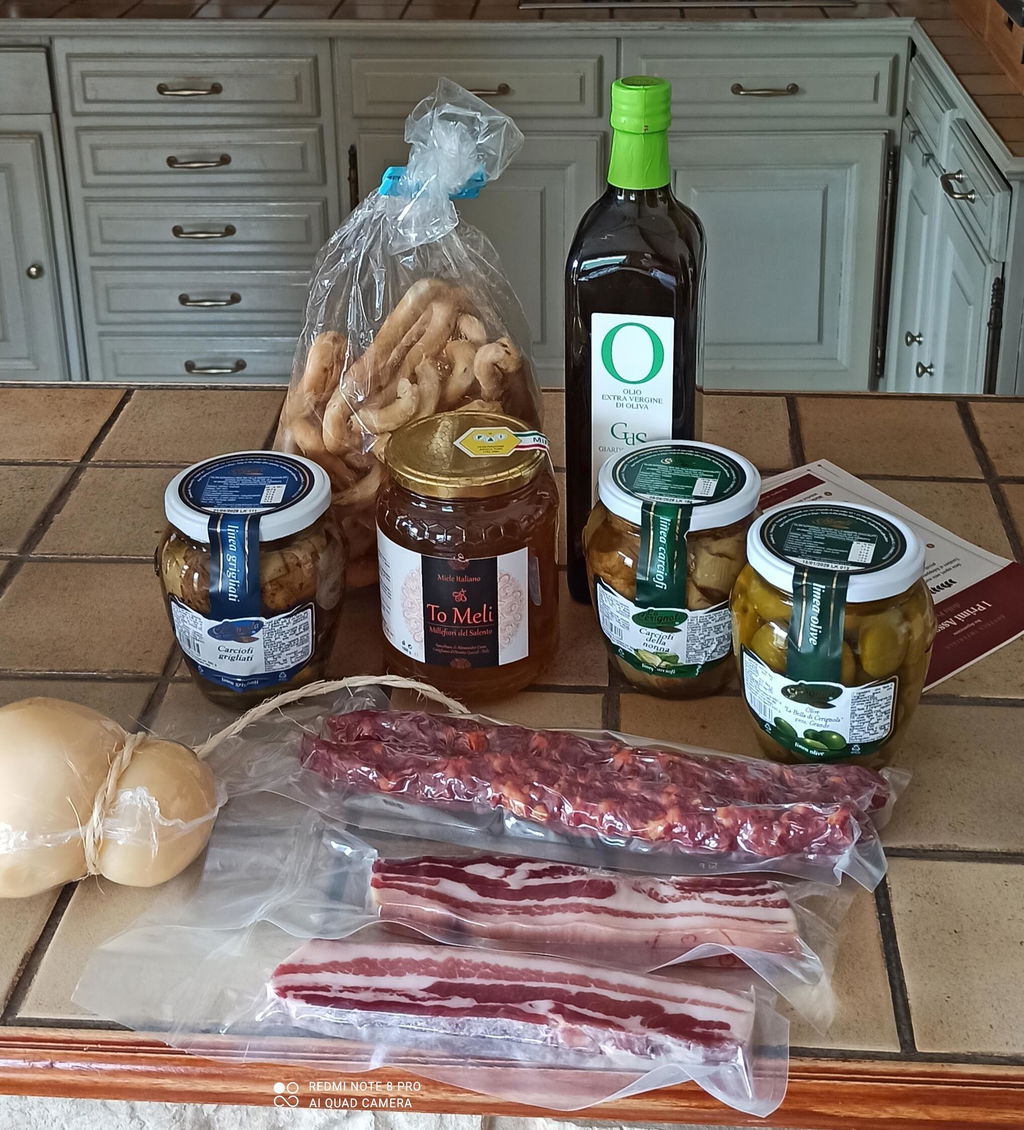
"I Primi Assaggi della Puglia" is our starter box: seven products from small producers we know personally — the oil from the Iaculli family mill in Cerignola, the scaldatelli from Francesco Di Biase in the Daunian Subappennino, the raw honey from Salento by Alessandro Cuna, the artichokes grown and preserved by Mario. All in real sizes, no samples.
→ Discover I Primi Assaggi della Puglia at bottegaimperiale.it 👈
We ship throughout Italy and Europe. And if you are looking for a specific product you tasted on vacation and don’t know what it’s called, feel free to write to us and describe it: in most cases, we can identify it.