What to put in a box of Apulian products — and what to leave out
Bottega Imperiale · A guide to putting together a food box that actually gets eaten.
There is a fate common to many food gift baskets: they are opened, admired, photographed, and acknowledged with a thank you. Then, they end up at the back of the pantry. A year later, someone finds them and throws away half of the expired contents.
This doesn't happen because the products were bad. It happens because that box was designed to look impressive the moment it was opened, not to be eaten. Those are two different goals, and they are almost always in conflict with each other.
This guide is meant to help you compose—or choose—a Puglian box that actually ends up on the table. It applies whether you are preparing it as a gift, if you need to order fifty for your clients, or if you simply want to understand what you are buying before you spend your money.
The rule that matters more than all the others
Better a few recognizable products than twenty anonymous sample sizes.
A sample size communicates only one thing: "a taste." And tasting is a gesture that gets put off. A 40-gram jar doesn't fit into any real meal because it isn't enough for two people, and no one wants to "waste" it on a random dinner. So, it stays there.
A full-size product communicates the opposite: "use this." A half-liter bottle of oil enters the kitchen rotation within a week. A 20ml single-serving packet stays in the drawer along with sugar sachets from a highway rest stop.
If you have to choose between twelve small products and six real ones for the same price, take the six. The recipient will remember what they ate, not what they counted.
The six things a Puglian box should have:
1. One protagonist, and only one.
A box needs one product around which everything else revolves. In Puglia, that product is extra virgin olive oil, and it's not a romantic choice: it’s the only ingredient the recipient will use every single day, and therefore the only one that can turn a gift into a habit. If the oil is good, there will be a second time. If the oil is anonymous, that’s the end of the box.
Always ask three questions before putting it in: who made it, where the olives were grown, and above all, when they were harvested. If the seller doesn't know the answer, you have your answer.
2. Something that opens within five minutes.
Every box needs a product that can be eaten immediately, without cooking, preparation, or decision-making. In Puglia, these are the baked goods: taralli, scaldatelli, friselle. They serve to break the ice with the package—and to immediately establish the quality we're talking about, because the difference between an artisanal scaldatello and a supermarket tarallo is felt on the first bite, with no explanation needed.
3. Something that gets opened in front of other people.
An aged cheese or a vacuum-sealed cured meat does something other products don't: it creates an occasion. They get sliced when guests arrive, shared, and discussed. This is the item that makes people talk about the box out loud—and therefore, quite concretely, it is the piece that brings you the next client.
Pay attention to the format: it must withstand the journey and the pantry. Aged or vacuum-sealed, yes; fresh, no—and we will return to fresh products in a moment.
4. A vegetable preserved in oil that saves a dinner.
Artichokes, mushrooms, eggplants, peppers. These are the most underrated products in a box and actually the most used, because they answer the most frequent question in any Italian home: "What can I prepare tonight that is quick but not sad?" A jar of artichokes in oil becomes an appetizer, a side dish, a pasta topping, or a focaccia filling.
5. Something sweet that lasts.
Honey, jam, a chocolate spread, or vincotto. They serve two purposes: to close the box with a note other than savory, and to stay in the pantry for months without spoiling. It’s the product the recipient will rediscover in March, when the memory of the gift has already faded—and it will spark your name again.
6. Real sizes, not miniatures.
Let’s repeat this because it’s where almost everyone goes wrong: a box with six real-sized products is worth much more in the eyes of the recipient than a basket with fifteen samples. The latter looks richer for thirty seconds. The former is consumed for three months.
What to leave out:
Taking things out is harder than adding them, because every excluded product feels like an impoverishment. In reality, it’s almost always the opposite. Here are the five categories to eliminate without regrets.
- Duplicates of the same category. Two types of taralli and two preserves don't double the value: they double the boredom. A box is judged by the variety of use cases, not the number of pieces.
- Fresh products that don't make sense outside of Puglia. Burrata is a textbook case: eaten eight hours after production, it’s an experience; inside a shipped box, it becomes a disappointment that the recipient will blame on you. Perishable fresh products should be sold separately, with refrigerated shipping and specified delivery—never tucked into a gift that might sit in a reception area for two days.
- Anything that doesn't have a name behind it. If you can't write who made a product and where, that product is lowering the quality of the box. The same applies to the recipient: "a Puglian oil" is forgotten; "Mario's oil, from a family-run mill using only Coratina olives from his own farm" is not.
- Fillers. Generic semolina pasta, a pack of breadsticks, a bag of spices added just to add bulk. Anyone who opens the box recognizes it immediately—and retroactively begins to doubt the rest of the contents, too.
- Randomly chosen wine. A good bottle is worth it, a bottle added just to inflate the perceived value is not. Wine is heavy, risks breaking during shipping, and restricts the countries to which you can send it. If it’s not a label you stand behind by name, leave it out.

The three-question test
Before sealing the box, run every single product through these three questions. If even one answer is "no," that product stays out.
Can I say who made it and where?❓ (If the answer is a name and a town, it's in.)
Does the recipient know what to do with it on a random Monday night? ❓(If it requires a special occasion, it will remain closed.)
After finishing this, would they buy it again?❓ (If the answer is no, that product is taking the place of one that would.)
How "The First Taste of Puglia" is made.
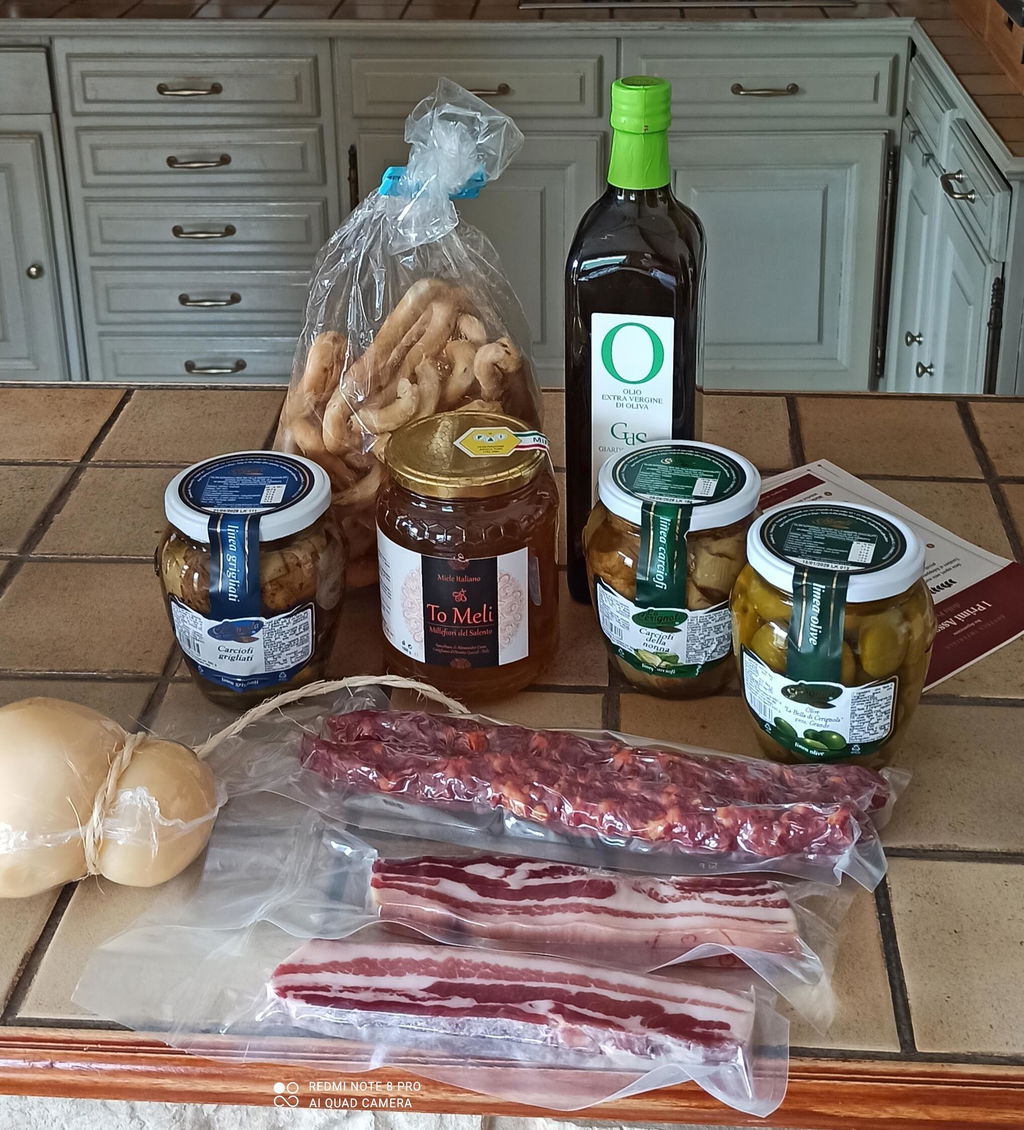
Our starter box was created exactly according to these rules. Seven products, all in real sizes, all with a name behind them.
👉 100% Puglian extra virgin olive oil, cold-pressed by the Giardino del Sole mill owned by Mario Iaculli in Cerignola: a family business that has been milling for over fifty years. It is the protagonist of the box.
👉 Scaldatelli or Taralli by Francesco Di Biase, a third-generation baker from the Daunian Subappennino, made only with Italian wheat and milled semolina. They are the product you open first.
👉 Caciocavallo from the Gargano, to be sliced and put on the table when someone arrives.
👉 Artisanal "knife-point" sausage, processed just as it was before being bought at a supermarket meat counter. Giant olives, the side dish that is never missing in Puglia.
👉 Grandma's Artichokes, grown by Mario on his fertile land and preserved in sunflower oil: the jar that solves a dinner. The quality and taste that you cannot find on a supermarket shelf.
👉 Raw, unpasteurized "Millefiori" honey from the Salento "To Meli" by Alessandro Cuna, a beekeeper in Corigliano d’Otranto, registered with the Italian Beekeepers Federation. It is the product that will stay in the pantry longer than any other, but I guarantee a real improvement for your health.
No samples. No fillers. Seven products that the recipient will actually finish.
Taste the Puglia that you can't find at the supermarket.
The First Taste of Puglia is the box with which almost all our customers begin: seven products from seven small producers we know personally, chosen to be eaten and not watched. Shipping throughout Italy and Europe.
→ Discover The First Taste of Puglia by clicking here 👈
Do you need to compose a custom box, for yourself or your corporate clients? You can contact us: we will build it together starting from the six rules in this guide.